Ralph Larson · Independent Edition
Introspective Narrative · Memory, Displacement & Reconstruction
About the work
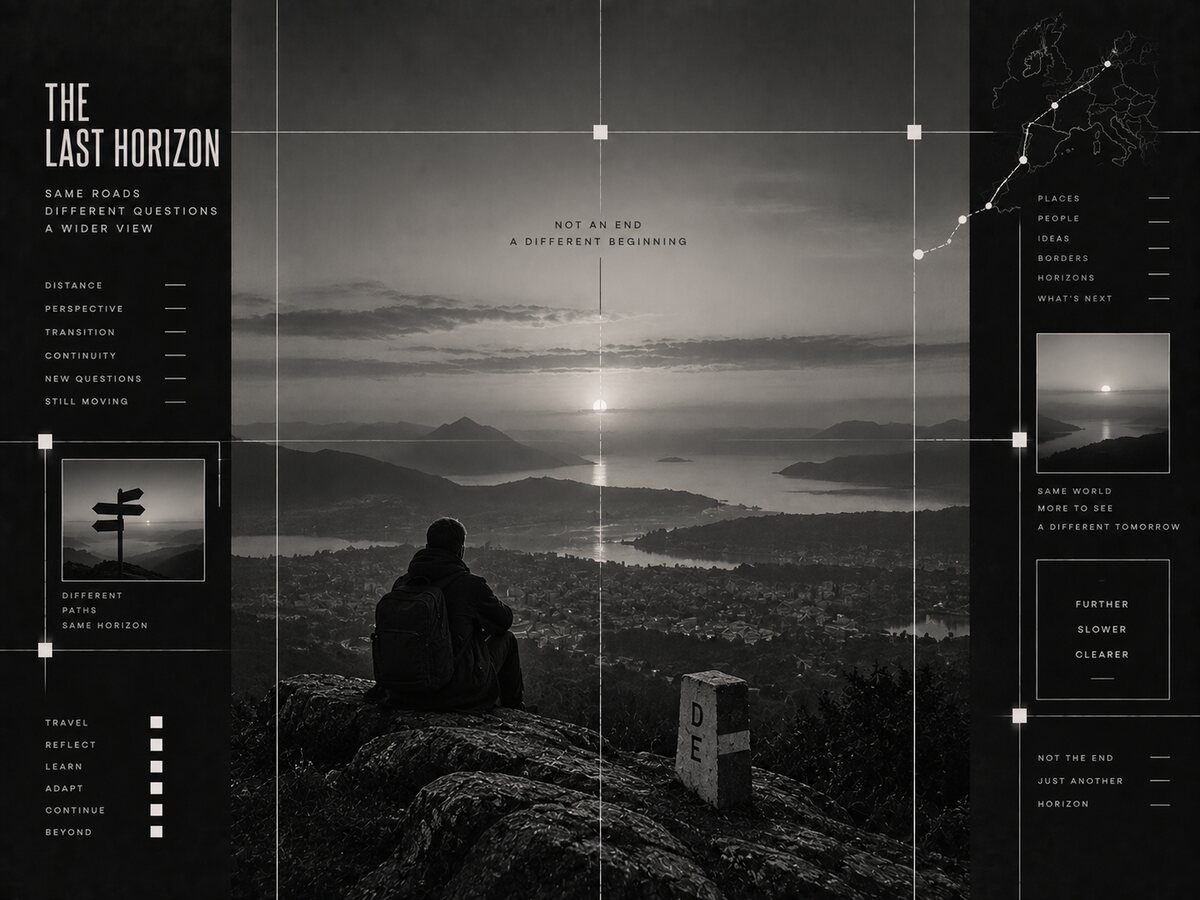
The Last Horizon explores the horizon as a boundary of observation.
A horizon appears to mark the point at which the visible world ends. Yet it is not a fixed geographical limit. It exists because an observer occupies a particular position.
Move the observer and the horizon moves too.
What previously remained beyond observation may become visible, while another limit appears further ahead.
The same structure can be applied to internal experience.
Understanding does not necessarily eliminate uncertainty. It may simply change the position from which uncertainty is observed.
This produces the central proposition of the work:
The horizon is not a destination. It is the limit produced by the position of the observer.
The visible limit
A horizon creates the appearance of a boundary.
Everything before it can, at least potentially, be observed.
Everything beyond it remains unavailable.
But the boundary does not belong entirely to the landscape.
It belongs to the relationship between landscape and observer.
Change the position of observation and the boundary changes with it.
The limit is therefore relational rather than absolute.
Moving toward the horizon
The horizon creates an unusual paradox.
It can provide direction without providing a destination.
The observer can move toward it indefinitely, but arrival causes the previous horizon to disappear and another to emerge.
Progress therefore does not abolish the limit of observation.
It relocates it.
Every new position reveals something and conceals something else.
This makes the horizon a useful model for introspective observation.
The limits of self-observation
An internal system cannot simply leave itself in order to observe its operation from an entirely external position.
The observer remains part of the system being observed.
Every interpretation is therefore produced from somewhere within that system.
A new understanding can modify the position of the observer.
But that new position generates its own limits.
This is why introspective observation cannot produce a final panoramic view.
Introspection is observation without externality.
What becomes visible
Change can reveal information that was previously inaccessible.
Distance may alter the meaning of an event.
Time may reduce the importance of an old uncertainty.
A later experience may expose a pattern that could not be recognised while it was occurring.
None of this necessarily means that the previous observer was mistaken.
The previous observer occupied another position and therefore had another horizon.
The information available from that position was different.
Memory and distance
Memory also has horizons.
Some experiences remain immediately accessible.
Others become indistinct.
Details disappear while interpretations survive.
In other cases, the opposite occurs: an isolated detail remains vivid even after the wider context has faded.
The remembered past is therefore not a complete landscape preserved unchanged behind the observer.
It is reconstructed from the present.
As the observer changes position, the accessible configuration of memory changes with it.
The temptation of the final answer
Uncertainty frequently produces a desire for closure.
The observer imagines that one additional fact, one explanation or one final conversation will complete the picture.
Sometimes it does.
But other forms of uncertainty cannot be eliminated in this way.
Additional information changes the configuration without making observation complete.
A question is answered and another becomes visible.
An explanation resolves one contradiction while exposing another.
The system moves forward.
The horizon moves with it.
Beyond resolution
Not every unresolved question requires an answer in order for the system to continue.
This distinction is important.
Resolution changes the informational status of a question.
Adaptation changes the relationship of the system to that question.
The first may depend upon information that never arrives.
The second can occur without it.
A system may continue beyond a question without ever reaching the answer it once considered necessary.
The last horizon
The title appears to contain a contradiction.
If horizons move with the observer, there should never be a final one.
The contradiction is deliberate.
The last horizon is not necessarily the final boundary of knowledge.
It may instead be the last horizon that the observer still feels compelled to cross.
At some point, movement no longer needs to be organised around what remains beyond the visible limit.
The unknown continues to exist.
Its regulatory function changes.
Stopping without arriving
There is a difference between reaching a destination and ceasing to pursue one.
The first depends upon arrival.
The second depends upon the system no longer requiring arrival in order to remain stable.
This creates another possible form of closure.
The observer does not conquer the horizon.
The observer simply stops organising movement around it.
The horizon remains. The need to reach it does not.
The observer after the journey
Movement changes observation even when it does not produce certainty.
The observer who has crossed several previous horizons carries information that was unavailable at the beginning of the journey.
Some expectations have been confirmed.
Others have disappeared.
Some memories have been reconstructed.
Some questions remain open.
The result is not a completed system.
It is a differently configured one.
Within the Introspective Narrative corpus
The Last Horizon closes the sequence of works concerned most directly with travel, memory and displacement.
In Trabant Nights, movement changes the position from which place and memory are observed.
In Reflected Voices: Berlin 2025, return confronts remembered representation with a new observation.
In The Invisible Road, the external journey becomes a structure for observing internal displacement.
The Last Horizon takes the sequence to its conceptual limit.
The question is no longer where the observer travels, returns or arrives.
The question is whether observation itself can ever reach a final position.
The answer remains deliberately incomplete.
Every position produces a horizon.
But not every horizon needs to be crossed.
Themes
Systems · Observation · Memory · Uncertainty · Interpretation ·
Adaptation · Transformation · Internal Representation · Identity · Self-Regulation
Edition and availability
The Last Horizon is published as a compact paperback edition of approximately 100 pages, forming part of Ralph Larson’s Introspective Narrative corpus.
The complete text is not published online. The work is issued in a limited printed edition and is available through specialist bookshops handling small and independent editions.
For professional and research use, authorised readers may be provided with private digital access. A username and password are required.