
Ralph Larson · Independent Edition
Introspective Narrative · Memory, Displacement & Reconstruction
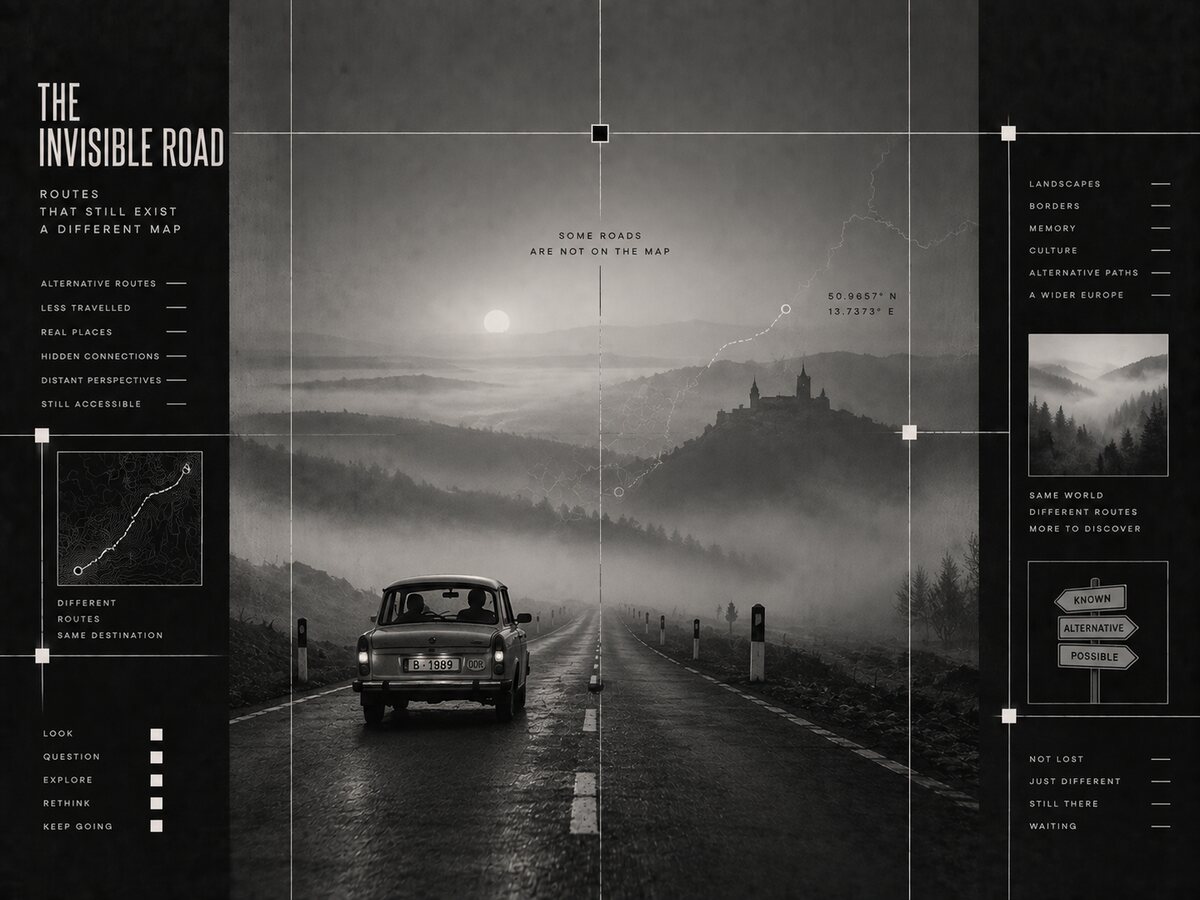
About the work
The Invisible Road explores the relationship between physical movement and internal transformation.
A journey can be described through roads, distances, places and destinations. These elements belong to the visible route.
But another journey may occur simultaneously.
Memory is activated. Expectations change. Previous interpretations are reconsidered. Experiences that appeared disconnected begin to acquire a different relationship with one another.
None of this appears on the map.
This is the invisible road.
Not every journey can be mapped. Some roads become visible only through the changes they produce in the observer.
Two journeys
Movement creates a simple external sequence:
departure → route → arrival
The internal sequence is less predictable.
A place may activate a memory. A delay may alter an expectation. An unfamiliar landscape may produce an unexpected comparison with something experienced years earlier.
The external journey follows geography.
The internal journey follows association.
Both occur at the same time, but they do not necessarily move in the same direction.
The road as a system
A road is normally understood as infrastructure connecting one location with another.
From a systemic perspective, however, it also creates a sequence of changing environments.
The observer continuously receives new information.
Landscape changes.
Visibility changes.
Familiar references disappear and new ones appear.
Movement prevents the environment from remaining stable.
The journey therefore becomes a continuous interaction between an external system in transition and an internal system attempting to interpret it.
Movement and observation
Observation changes when the observer is moving.
A stationary observer can return repeatedly to the same object.
A traveller often cannot.
A building appears and disappears.
A landscape remains visible for several minutes and then is replaced by another.
A junction requires a decision before complete information is available.
The observer must construct continuity from fragments.
This resembles the way internal experience is often reconstructed: not from a complete record, but from partial observations connected retrospectively.
What the map cannot represent
A map can describe distance.
It can identify roads, borders, cities and alternative routes.
It cannot represent the informational consequences of travelling through them.
Two people can follow the same road and complete entirely different journeys.
Even the same person can travel the same route twice without reproducing the same experience.
The external coordinates may coincide.
The internal position does not.
A route can be repeated geographically without being repeated introspectively.
Displacement
Physical displacement changes the position from which the environment is observed.
Internal displacement changes the position from which previous experience is interpreted.
The two processes can interact.
Leaving a familiar environment temporarily interrupts routines and removes some of the signals that normally regulate everyday behaviour.
Other signals become more visible.
Distance can therefore alter observation without providing any new explanation.
The facts may remain unchanged while their relationship within the observing system changes.
Memory along the route
Travel frequently activates memory through apparently minor details.
A road.
A station.
A particular type of building.
A landscape whose structure resembles another landscape.
The connection may be geographically irrelevant but internally significant.
Memory does not necessarily reconstruct experience according to chronology or physical proximity.
It follows connections produced within the observing system.
The invisible road can therefore cross periods of time as easily as it crosses places.
Uncertainty and direction
Roads imply direction.
Internal processes rarely provide such clarity.
The traveller may know the geographical destination while remaining uncertain about the significance of the journey.
This creates an important distinction between destination and resolution.
Arrival can complete the physical route without resolving the internal process activated during it.
Conversely, an internal reconfiguration may occur before the external destination is reached.
The end of the road and the end of the journey are not necessarily the same event.
The observer in transit
The observer at departure is not necessarily identical to the observer at arrival.
This does not require dramatic transformation.
Small changes in interpretation are sufficient.
A previous certainty may become a question.
An unresolved question may lose importance.
A memory may acquire a different position within the internal system.
A destination previously imagined may become ordinary when finally reached.
The journey changes the informational environment, and the observer adapts continuously to that change.
No external observer
The difficulty of introspective observation becomes particularly visible during movement.
The person experiencing the journey is also the person attempting to understand what the journey is producing.
There is no independent observer positioned outside the process.
Interpretation therefore becomes part of the system being interpreted.
This is one of the central problems of Introspective Narrative:
introspection is observation without externality.
The invisible road cannot be observed from above in the way a geographical route can.
It can only be reconstructed from within the movement itself.
Arrival
Arrival appears to provide closure because movement stops.
But physical arrival does not necessarily restore stability.
The information accumulated during the route remains within the system.
Some of it may be immediately integrated.
Some may acquire significance only later.
Some may never become consciously important.
The visible road ends at a location.
The invisible road may continue after the traveller has stopped moving.
Within the Introspective Narrative corpus
The Invisible Road continues the exploration of movement, memory and observation developed in Trabant Nights and Reflected Voices: Berlin 2025.
In Trabant Nights, movement through Berlin transforms the position of the observer and the way memory interacts with place.
In Reflected Voices, return introduces a second observation and confronts remembered representation with present experience.
The Invisible Road moves the question inward.
The external journey remains present, but geography is no longer the principal object of observation. The journey becomes a structure through which internal displacement can be examined.
The work also connects with Metanoia, where adaptation requires reconfiguration rather than restoration, and with The Threshold, where incomplete information becomes interpretation within the observing system.
Across these works, movement does not provide automatic answers.
It changes the position from which questions are observed.
Themes
Systems · Observation · Memory · Internal Representation · Identity ·
Adaptation · Transformation · Uncertainty · Interpretation · Self-Regulation
Edition and availability
The Invisible Road is published as a compact paperback edition of approximately 100 pages, forming part of Ralph Larson’s Introspective Narrative corpus.
The complete text is not published online. The work is issued in a limited printed edition and is available through specialist bookshops handling small and independent editions.
For professional and research use, authorised readers may be provided with private digital access. A username and password are required.