
Ralph Larson · Independent Edition
Introspective Narrative · Conscience, Transformation & Adaptation
About the work
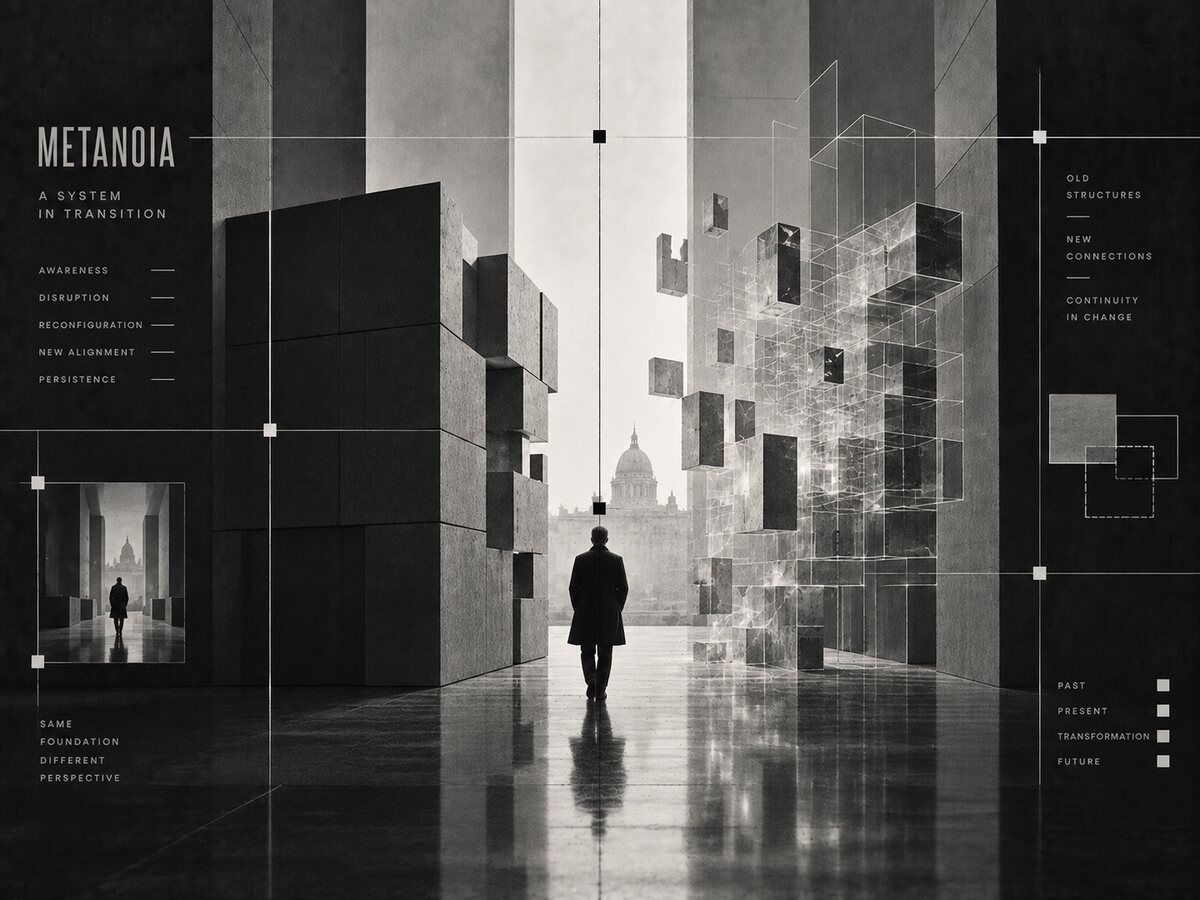
Metanoia explores transformation after the internal configuration that once organised experience can no longer be maintained.
Its starting point is not change as aspiration, improvement or reinvention. It is change as a systemic consequence.
Something has been lost. A relationship, certainty, identity, expectation or previous way of understanding the world no longer performs the function it once did.
The system cannot simply return to its previous state because the experience of loss has itself become new information.
What follows is therefore not restoration.
It is reconfiguration.
The system does not return to what it was. It reorganises around what has happened.
After loss
Loss is normally described in terms of what disappears.
Metanoia approaches it from another direction: what remains after disappearance?
Memory remains.
Information remains.
Internal representations may remain.
Habits, expectations and interpretative structures may continue operating after the external conditions that originally produced them have changed.
The system therefore confronts an asymmetry.
Something can disappear externally without disappearing immediately from the internal structure organised around it.
The impossibility of restoration
Restoration suggests a return to an earlier configuration.
For many systems, this is possible. A machine can be repaired. A building can be reconstructed. A previous technical state can sometimes be recovered.
Internal systems are different because experience cannot simply be removed from their history.
Once an event has been incorporated, the system that emerges afterwards contains information that the earlier system did not possess.
Even if external circumstances were somehow restored, the observer would no longer occupy exactly the same position.
Returning to the same place does not recreate the system that first arrived there.
Transformation without design
Not every transformation begins with a decision to change.
Systems often adapt because their previous configuration has become insufficient.
A perturbation introduces information that cannot be processed through existing structures. Contradictions become visible. Expectations fail. Previous explanations lose regulatory usefulness.
The system must then modify itself.
This process may initially appear as instability rather than transformation.
The old configuration no longer works, while the new one has not yet acquired coherence.
Metanoia is particularly interested in this intermediate state.
Between configurations
Transformation contains a period in which neither the previous nor the emerging configuration provides complete stability.
The old system remains partially active.
Memories retain their former associations.
Expectations continue to appear automatically.
Old interpretative routines attempt to process new information.
At the same time, new functions begin to emerge.
What previously produced perturbation may become material for observation. What once required an external answer may gradually become internally manageable. What was experienced only as loss may acquire another function.
The system exists temporarily between its own versions.
What finds
The subtitle, What Finds When All Has Been Lost, deliberately reverses the conventional direction of the question.
After loss, the individual does not merely search for something new.
New configurations can also emerge through the process itself.
An unexpected interest appears.
A dormant capacity becomes active.
A different interpretation becomes possible.
A new environment acquires significance.
Something that would not have been visible from the previous configuration becomes available only because that configuration has been disrupted.
Transformation does not only discover what was missing. It can make previously inaccessible possibilities observable.
Memory without return
Adaptation does not require the elimination of memory.
The past can remain accessible without continuing to organise the present.
This distinction is essential.
A memory can persist while losing regulatory dominance.
An internal representation can survive while ceasing to determine expectation.
An experience can remain significant without requiring repetition.
The system therefore does not need to erase its previous configuration in order to move beyond it.
It changes the position that configuration occupies within the whole.
Reconfiguration
Reconfiguration is not synonymous with improvement.
A system can change without becoming objectively better.
The relevant question is whether the emerging structure can process the information and conditions that the previous configuration could no longer manage.
Some functions weaken.
Others become more important.
Boundaries change.
Expectations are recalibrated.
Interpretative routines are modified.
The resulting system may preserve substantial continuity with its previous form while operating according to a different internal organisation.
Adaptation without forgetting
There is a temptation to describe transformation through elimination: leaving the past behind, forgetting, starting again.
Metanoia proposes a different image.
The information remains, but its function changes.
A disruptive event may become knowledge.
An unresolved question may become unnecessary.
A painful representation may become memory rather than expectation.
A former dependency may become observation.
Adaptation does not require deleting the past. It requires changing what the past is allowed to regulate.
The observer after transformation
Transformation also changes the observer.
An event interpreted from the previous configuration may acquire a different meaning from the new one.
The historical facts remain approximately the same, but their position within the system has changed.
This means that metanoia is not simply the replacement of one interpretation by another.
It changes the structure from which interpretation occurs.
The observer looks back and discovers that the question itself may have changed.
No final configuration
Reconfiguration does not produce a permanent endpoint.
The transformed system remains exposed to new information, new environments and future perturbations.
Stability is therefore provisional.
The importance of transformation lies not in reaching a final state but in acquiring another way of processing what happens next.
The system continues.
But continuation does not require restoration.
Within the Introspective Narrative corpus
Metanoia develops the concepts of adaptation and reconfiguration introduced in The System.
It connects with The Threshold, where an unresolved event may cease to require an answer once the system adapts to uncertainty. In Metanoia, that possibility becomes a broader process of transformation.
It also intersects with The Toxic Muse, where perturbation can be transformed into creative material, and with The Equation of Silence, where expectations and internal representations may survive after external communication has disappeared.
Later works concerned with memory and reconstruction approach the same problem from another direction: the transformed observer encounters the past without being identical to the person who originally experienced it.
Across these works, transformation is not understood as erasure.
The system preserves its history while changing the function that history performs.
Themes
Systems · Transformation · Adaptation · Internal Functions ·
Self-Regulation · Memory · Internal Representation · Perturbation ·
Observation · Identity · Uncertainty
Edition and availability
Metanoia is published as a compact paperback edition of approximately 100 pages, forming part of Ralph Larson’s Introspective Narrative corpus.
The complete text is not published online. The work is issued in a limited printed edition and is available through specialist bookshops handling small and independent editions.
For professional and research use, authorised readers may be provided with private digital access. A username and password are required.