Ralph Larson · Independent Edition
Introspective Narrative · Everyday Systems
About the work
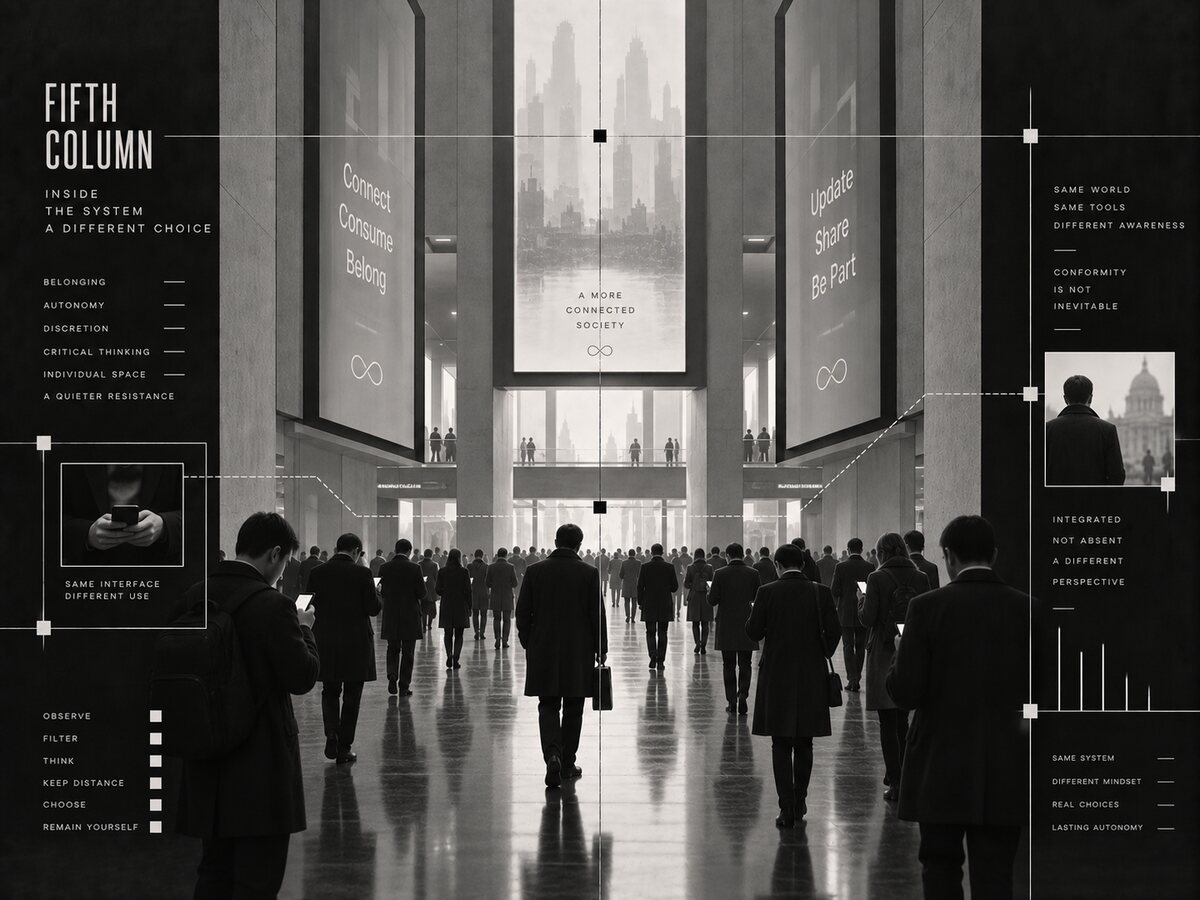
Fifth Column explores the possibility of autonomy from within a system.
The individual remains connected.
He uses the same technologies, moves through the same environments and participates in many of the same structures as everyone around him.
From the outside, he belongs to the system.
But participation does not necessarily imply conformity.
A person may inhabit a system without reproducing every pattern the system encourages.
This produces the central proposition of the work:
Belonging to the system does not imply obeying all its patterns.
Inside the system
Resistance is often imagined as something external.
The individual rejects the system, leaves it or openly opposes it.
Fifth Column examines another possibility.
The individual stays.
He remains technologically connected, socially present and functionally integrated.
The difference lies not in physical separation but in behaviour.
He observes patterns without automatically reproducing them.
Autonomy therefore becomes possible without exile.
Participation and conformity
Participation requires interaction.
Conformity requires something more.
It requires the repeated adoption of patterns because those patterns have become normal within the surrounding system.
The distinction can be difficult to observe.
Two people may carry the same device.
Both may use the same applications.
Both may belong to the same communication networks.
Yet their relationship with those systems can be fundamentally different.
One responds automatically to the environment.
The other preserves an interval between signal and response.
The interval
That interval is central to Fifth Column.
A notification appears.
Nothing requires an immediate response.
A social pattern becomes visible.
Nothing requires its reproduction.
A new technological habit becomes widespread.
Nothing requires its adoption simply because everyone else has adopted it.
Between stimulus and behaviour there remains a small space in which observation can occur.
Autonomy begins where automatic response becomes observable.
The invisible dissenter
The autonomous participant may be difficult to identify.
There is no uniform.
No declaration is necessary.
No visible opposition needs to occur.
In a crowd looking at screens, the difference may consist simply of one person choosing not to look.
That person has not abandoned technology.
He has interrupted a pattern.
The distinction is minor externally but potentially significant systemically.
Why Fifth Column?
The title deliberately borrows the language of infiltration.
But the metaphor is redirected inward.
The individual is not an agent attempting to destroy the surrounding system.
Nor is he necessarily hostile to it.
He occupies a position inside the system while retaining behavioural independence from some of its dominant patterns.
The “fifth column” is therefore not an organised group.
It is a position of observation.
The observer participates in the system without allowing participation to eliminate distance from it.
Normality as information
Systems communicate expectations partly through repetition.
When almost everyone behaves in the same way, the behaviour begins to appear natural.
But frequency does not transform a pattern into necessity.
It only makes deviation more visible.
The autonomous participant notices this distinction.
What everyone does is information about the system.
It is not automatically an instruction for the individual.
The cost of difference
Autonomy is not necessarily dramatic, but it is not always free.
Departing from an established pattern may create inconvenience.
Responses may be slower.
Some services may become less convenient.
Other people may interpret selective availability as unusual.
The system frequently rewards conformity simply because its infrastructure has been designed around common behaviour.
Autonomy therefore involves deciding which conveniences justify adaptation and which adaptations unnecessarily surrender choice.
Technology without submission
Fifth Column is not an argument for technological withdrawal.
A person can use navigation, messaging, digital authentication, artificial intelligence or online services without accepting every behavioural pattern associated with them.
The relevant distinction is between using a tool and allowing the tool to determine the structure of attention.
Technology can extend capability.
It can also establish routines.
The systemic question is whether those routines remain visible to the person performing them.
Observation as resistance
Resistance does not always require refusal.
Sometimes observation is sufficient to interrupt automatic behaviour.
A pattern that remains invisible is difficult to evaluate.
Once observed, it becomes available for choice.
The individual can reproduce it, modify it or reject it.
This does not guarantee independence from the system.
No participant is completely external to the environments in which he operates.
But awareness changes the relationship between environment and response.
To observe a pattern is already to cease following it entirely without question.
Autonomy within constraints
Absolute autonomy is not the objective.
Every system imposes constraints.
Language, infrastructure, institutions, technology and social expectations define part of the environment in which choices are made.
The individual cannot reconstruct that environment continuously from first principles.
Nor would doing so necessarily be useful.
Autonomy therefore exists within constraints.
It consists not in escaping every system, but in preserving the capacity to distinguish between what the system requires and what the individual has merely learned to reproduce.
The internal fifth column
The metaphor can also be applied internally.
Repeated external behaviour may become an internal function.
The user checks before the notification arrives.
Anticipates expectations before they are expressed.
Feels compelled to respond even when no response has been requested.
At this point the external system no longer needs to intervene directly.
Its pattern has acquired an internal representative.
Observation introduces another function: one capable of asking whether the response remains necessary.
The internal system therefore contains both adaptation and resistance.
Internal coherence does not require functional agreement.
Remaining inside
The most important act in Fifth Column is not departure.
It is remaining.
Remaining connected without being permanently available.
Using technology without allowing every notification to acquire priority.
Participating in contemporary systems without treating contemporary habits as inevitable.
The individual does not need to defeat the system.
He needs to preserve enough distance to continue observing it.
Within the Introspective Narrative corpus
Fifth Column is the conceptual counterpart to The New Obedience.
The New Obedience examines how interfaces, defaults, expectations and repeated signals can organise behaviour without explicit commands.
Fifth Column asks what happens when an individual recognises those patterns but remains inside the technological and social environment that produces them.
The two works therefore observe the same system from opposite positions.
One examines the formation of behavioural conformity.
The other examines the preservation of autonomy within it.
The work also connects with The System, where the individual is understood as interacting continuously with external social, technological and institutional systems.
The objective is not isolation.
It is maintaining an observable boundary between participation and automatic conformity.
Belonging does not require disappearance into the system.
Themes
Systems · Observation · Self-Regulation · System Boundaries ·
Adaptation · Internal Functions · Functional Conflict ·
Perturbation · Identity · Uncertainty
Edition and availability
Fifth Column is published as a compact paperback edition of approximately 100 pages, forming part of Ralph Larson’s Introspective Narrative corpus.
The complete text is not published online. The work is issued in a limited printed edition and is available through specialist bookshops handling small and independent editions.
For professional and research use, authorised readers may be provided with private digital access. A username and password are required.