Ralph Larson · Independent Edition
Introspective Narrative · Silence, Expectation & Interpretation
About the work
The Threshold explores the point at which observation becomes interpretation.
Its starting point is silence, but silence is not its true protagonist. The central figure is the observer who remains before an incomplete event and attempts, sometimes for years, to determine what it meant.
A conversation ends. A response never arrives. A departure remains unexplained. An apparently insignificant gesture survives in memory because the information required to interpret it was never available.
The external event may have lasted only minutes.
The internal process can last much longer.
This produces the central proposition of the work:
The true protagonist is not the one who stays silent, but the one who spends years trying to interpret it.
The threshold between observation and interpretation
An observable event contains limits.
A person spoke or remained silent. A message arrived or did not arrive. Someone stayed, left, returned or disappeared.
Beyond those facts begins another territory.
Why did it happen?
What did it mean?
What would have happened if the observer had acted differently?
These questions may be reasonable, but they no longer belong exclusively to observation.
They require interpretation.
The Threshold examines the moment at which the observing system crosses from what it knows into what it must construct.
The threshold is the boundary between available information and produced meaning.
Incomplete events
Some experiences acquire persistence precisely because they remain incomplete.
A fully explained event can be incorporated into memory with a relatively stable interpretation.
An unexplained event behaves differently.
It remains open to revision.
New memories can alter its apparent meaning. Later experiences can change the context in which it is understood. A detail previously considered irrelevant may suddenly become important.
The event itself does not change.
The system observing it does.
Meaning therefore becomes temporally unstable.
The observer after the event
The person interpreting an event years later is not the same observer who originally experienced it.
Information has accumulated.
Expectations have changed.
Other relationships have appeared and disappeared.
Experience has modified the interpretative framework through which the original event is reconstructed.
The past is therefore observed from a moving position.
This creates a paradox: greater distance may provide perspective while simultaneously increasing the distance between the present observer and the original experience.
The observer changes while the observed event remains fixed.
Silence as an open structure
Silence is particularly resistant to definitive interpretation because it contains no explanation of itself.
The observing system therefore has considerable freedom to construct one.
Indifference, fear, uncertainty, avoidance, protection, confusion or circumstances unrelated to the observer may all be possible explanations.
Possibility, however, is not evidence.
The absence of information can support multiple narratives precisely because it excludes very few of them.
This is why silence can remain interpretatively active long after it has ceased to have any practical consequence.
The architecture of uncertainty
Uncertainty does not necessarily remain empty.
The system can organise itself around it.
Memory supplies fragments.
Expectation reconstructs alternatives.
Interpretation connects events.
Imagination fills informational gaps.
Over time, these processes can produce an elaborate internal structure around an external event that originally contained very little information.
The resulting narrative may become internally coherent without becoming externally verifiable.
Coherence is not the same as confirmation.
Crossing the threshold repeatedly
The threshold between observation and interpretation is not crossed only once.
The observer can return to the same event repeatedly.
Each return begins with approximately the same historical material but occurs from a different present position.
A conclusion reached at one moment may later appear insufficient. A previously convincing explanation may lose relevance. Another interpretation may temporarily replace it.
The system does not necessarily search for the objectively correct narrative.
It may be searching for a configuration capable of reducing uncertainty.
Interpretation as regulation
Interpretation can perform a regulatory function.
An unexplained event leaves the system without a stable causal structure.
Constructing an explanation can reduce that instability.
The explanation does not need to be correct in order to perform this function.
It only needs to make the event sufficiently intelligible for the system to integrate it.
This creates an important distinction between truth and regulatory usefulness.
A narrative may stabilize the observer while remaining impossible to verify.
The Threshold does not resolve this contradiction. It observes it.
The danger of retrospective certainty
Time can create an illusion of clarity.
Once an interpretation has been repeated often enough, the distinction between what was observed and what was inferred may gradually weaken.
The reconstructed narrative begins to feel like memory.
Possible explanations become probable explanations.
Probable explanations may eventually be remembered as facts.
The systemic observer must therefore preserve a distinction between informational layers:
what happened, what was observed, what was inferred and what was later reconstructed.
Keeping those layers separate does not eliminate uncertainty.
It makes uncertainty visible.
When interpretation can stop
Not every unresolved event eventually receives an explanation.
Some questions remain structurally unanswered.
The system must then confront another possibility: adaptation without resolution.
The observer can stop interpreting not because the answer has been found, but because finding it is no longer necessary for equilibrium.
The unresolved event remains part of the system’s history without continuing to demand active processing.
This represents a different form of closure.
Resolution answers the question. Adaptation can make the answer unnecessary.
The threshold as a position
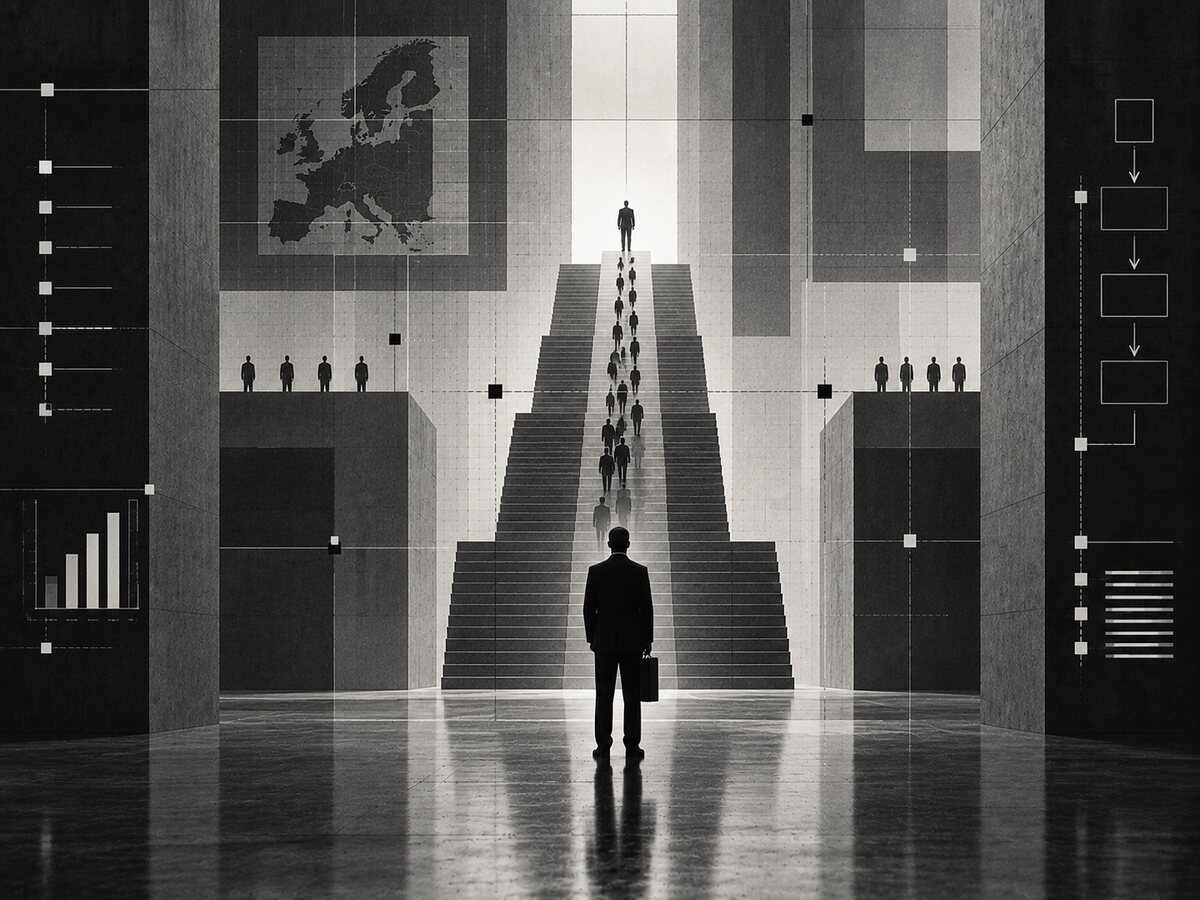
The title ultimately describes a position occupied by the observer.
Behind the threshold lies what can be established.
Beyond it lies interpretation.
Human experience continually requires movement between the two.
The objective is not to eliminate interpretation. Without interpretation, much of experience would remain unintelligible.
The objective is to recognise when the boundary has been crossed.
The observer can construct meaning while remembering that meaning has been constructed.
Within the Introspective Narrative corpus
The Threshold develops one of the methodological problems introduced in The System: the observer is part of the system being observed.
It connects directly with The Equation of Silence, but approaches silence from a different temporal perspective. The Equation of Silence examines how absence generates expectation and interpretation while a communicative pattern remains active. The Threshold asks what happens when the event itself belongs to the past but interpretation continues.
It also connects with The Toxic Muse, where an external person may disappear while an internal representation remains functionally active, and with Reflected Voices: Berlin 2025 and Trabant Nights, where memory and the changing position of the observer become central to reconstruction.
Across these works, interpretation is necessary but never neutral. The observer participates in the production of the meaning being observed.
Themes
Systems · Observation · Interpretation · Silence · Uncertainty ·
Memory · Absence · Internal Representation · Expectation ·
Self-Regulation · Adaptation
Edition and availability
The Threshold is published as a compact paperback edition of approximately 100 pages, forming part of Ralph Larson’s Introspective Narrative corpus.
The complete text is not published online. The work is issued in a limited printed edition and is available through specialist bookshops handling small and independent editions.
For professional and research use, authorised readers may be provided with private digital access. A username and password are required.