
Ralph Larson · Independent Edition
Introspective Narrative · Everyday Systems
About the work
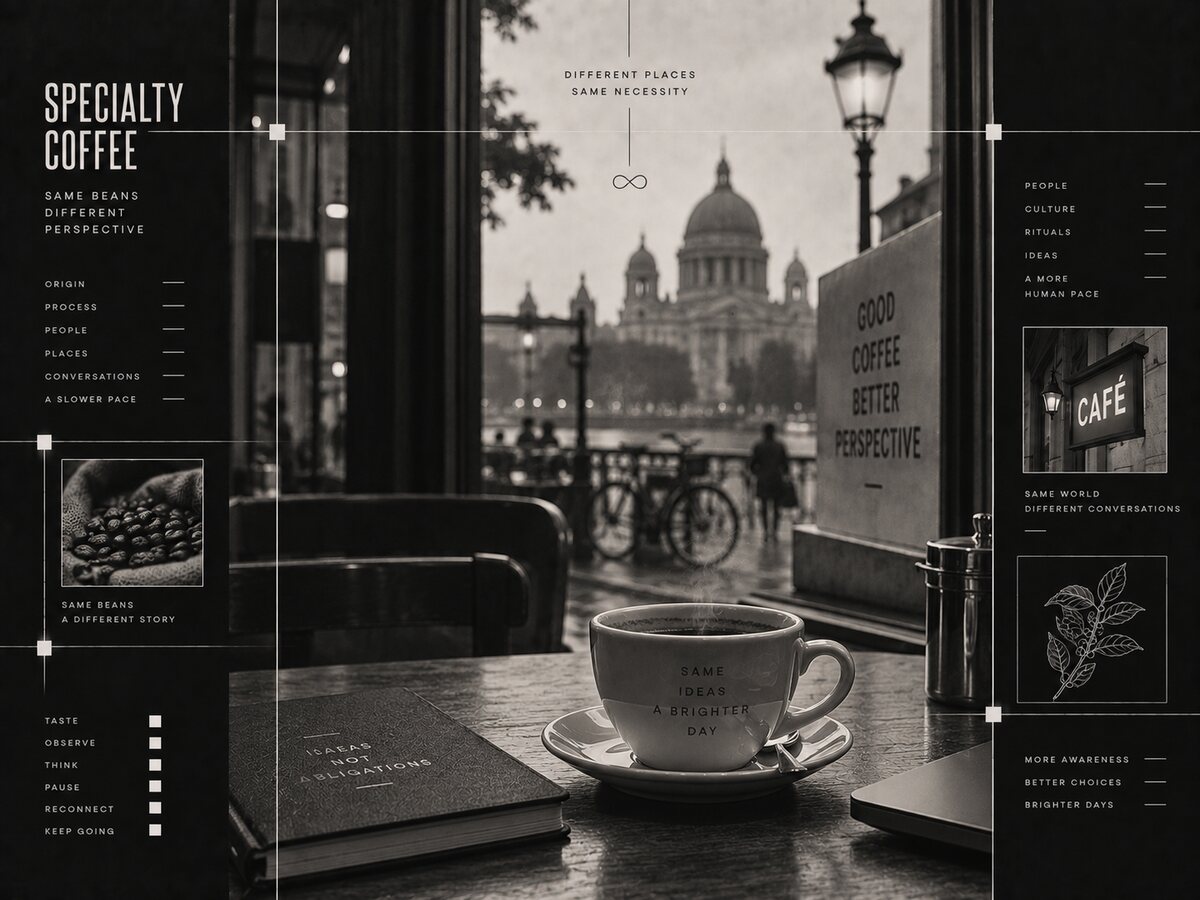
Specialty Coffee explores how apparently ordinary interactions can become structured by expectation, repetition and implicit rules.
Its starting point is deliberately simple: two people meet for coffee.
The coffee may be excellent. The place may be pleasant. The conversation may be effortless. None of this necessarily creates a problem.
The difficulty begins when the interaction acquires continuity.
A second meeting introduces expectation. A third may establish a pattern. Repetition can gradually transform an isolated event into a relational structure whose meaning is no longer contained in the coffee itself.
This produces the central proposition of the work:
The coffee was never the problem.
From event to pattern
A single interaction can remain self-contained.
Once it is repeated, however, the observing system begins to compare one event with another.
Frequency becomes information.
Timing becomes information.
Who proposes the next meeting becomes information.
Changes in tone, duration or location may also become information.
The individual interaction therefore becomes part of a larger sequence.
What was initially an event starts to function as a pattern.
The cost of continuity
Continuity is often treated as the natural consequence of a positive interaction.
Specialty Coffee questions that assumption.
Every recurring interaction introduces a small maintenance cost. Time must be allocated. Expectations emerge. Invitations require responses. Absence may need interpretation. Repetition creates a history against which future behaviour can be compared.
The system therefore acquires obligations that did not exist before.
These obligations may remain informal, but they can nevertheless influence behaviour.
A relationship can become structured without ever being explicitly defined.
Implicit rules
Human interactions frequently operate through rules that are never formally stated.
Who writes first?
How long should one wait before suggesting another meeting?
Does refusing once require explanation?
Does accepting repeatedly create an expectation of future availability?
When does courtesy become continuity?
When does continuity begin to resemble commitment?
Specialty Coffee treats these questions not as etiquette problems but as examples of how systems generate rules through repetition.
A pattern can become regulatory before anyone has consciously agreed to it.
Expectation as a system effect
Expectation does not necessarily require an explicit promise.
It can emerge from repeated behaviour.
If two people meet every week, the absence of the next meeting may acquire significance even though no formal agreement exists.
The system has learned a sequence.
Once the sequence becomes familiar, deviation becomes observable.
The same principle appears throughout Ralph Larson’s Introspective Narrative: patterns create informational expectations.
The apparently trivial interaction
The work uses coffee precisely because the setting appears insignificant.
There is no dramatic event.
No explicit declaration is required.
No institutional framework defines the relationship.
Yet even this minimal context can produce observation, expectation, uncertainty and regulation.
The ordinary situation therefore becomes a useful laboratory for examining how relational systems emerge from repeated behaviour.
When the ritual becomes the system
At a certain point, the ritual may become more stable than the meaning attached to it.
The participants continue to meet because they have been meeting.
The next coffee occurs because the previous coffee occurred.
Continuity begins to reproduce itself.
This creates a form of path dependence.
The system continues not necessarily because each participant has consciously decided that it should continue, but because continuation has become the default outcome.
Repetition can preserve a structure after its original meaning has become uncertain.
Regulation through routine
Routine can also perform a stabilizing function.
A recurring coffee may provide continuity during periods of uncertainty. It can create a predictable point within otherwise unstable schedules or relationships.
The ritual therefore becomes more than an event.
It can function as a small regulatory mechanism.
This does not necessarily imply emotional dependence or relational significance. The systemic question remains narrower:
what function does the recurring interaction perform?
The problem of interpretation
Once expectation exists, changes in the pattern invite interpretation.
A cancelled meeting may mean very little.
Repeated cancellations may appear to mean more.
A sudden increase in frequency may become noticeable.
A long silence after a stable pattern may generate uncertainty.
But the observable change and the meaning attributed to it remain different forms of information.
The system can identify a deviation without automatically knowing its cause.
This distinction connects Specialty Coffee with the broader methodological approach of the corpus:
observe the pattern before explaining the intention.
Courtesy, availability and maintenance
The work also considers a broader question: how long should low-intensity relational protocols continue merely because they already exist?
A recurring invitation, greeting or ritual can preserve access between people who may no longer share any substantial relational function.
The interaction continues because ending it would require a decision.
In this sense, some relationships can resemble unused subscriptions: the underlying function has weakened, but the maintenance protocol continues automatically.
The question is not whether this is right or wrong.
The question is whether the system is still performing a meaningful function or merely reproducing its own continuity.
The coffee as interface
Ultimately, the coffee itself is only an interface.
It provides a socially acceptable structure within which different functions can operate: conversation, observation, reassurance, curiosity, continuity, ambiguity or simple routine.
The same ritual can therefore perform different functions at different moments.
This is why the work refuses to assign a single meaning to the act.
A coffee is observable.
Its function belongs to the system in which it occurs.
Within the Introspective Narrative corpus
Specialty Coffee applies the systemic vocabulary of The System to an intentionally ordinary relational setting.
It intersects with The Equation of Silence through expectation, repetition and the informational significance of deviations from established patterns.
It also connects with The Stabilizer, where recurring interaction can perform a regulatory function, and with The Murmur of Balance, where continuity and withdrawal become part of a dynamic relational sequence.
Unlike those works, however, Specialty Coffee deliberately avoids dramatic relational configurations. Its purpose is to show that the same systemic mechanisms can become visible in routine, low-intensity interactions.
The ordinary can reveal the structure just as clearly as the exceptional.
Themes
Systems · Everyday Systems · Expectation · Observation · Interpretation ·
Routine · Repetition · Self-Regulation · Uncertainty · Perturbation ·
System Boundaries
Edition and availability
Specialty Coffee is published as a compact paperback edition of approximately 100 pages, forming part of Ralph Larson’s Introspective Narrative corpus.
The complete text is not published online. The work is issued in a limited printed edition and is available through specialist bookshops handling small and independent editions.
For professional and research use, authorised readers may be provided with private digital access. A username and password are required.