
Ralph Larson · Independent Edition
Introspective Narrative · Intimacy, Boundaries & Parallel Systems
About the work
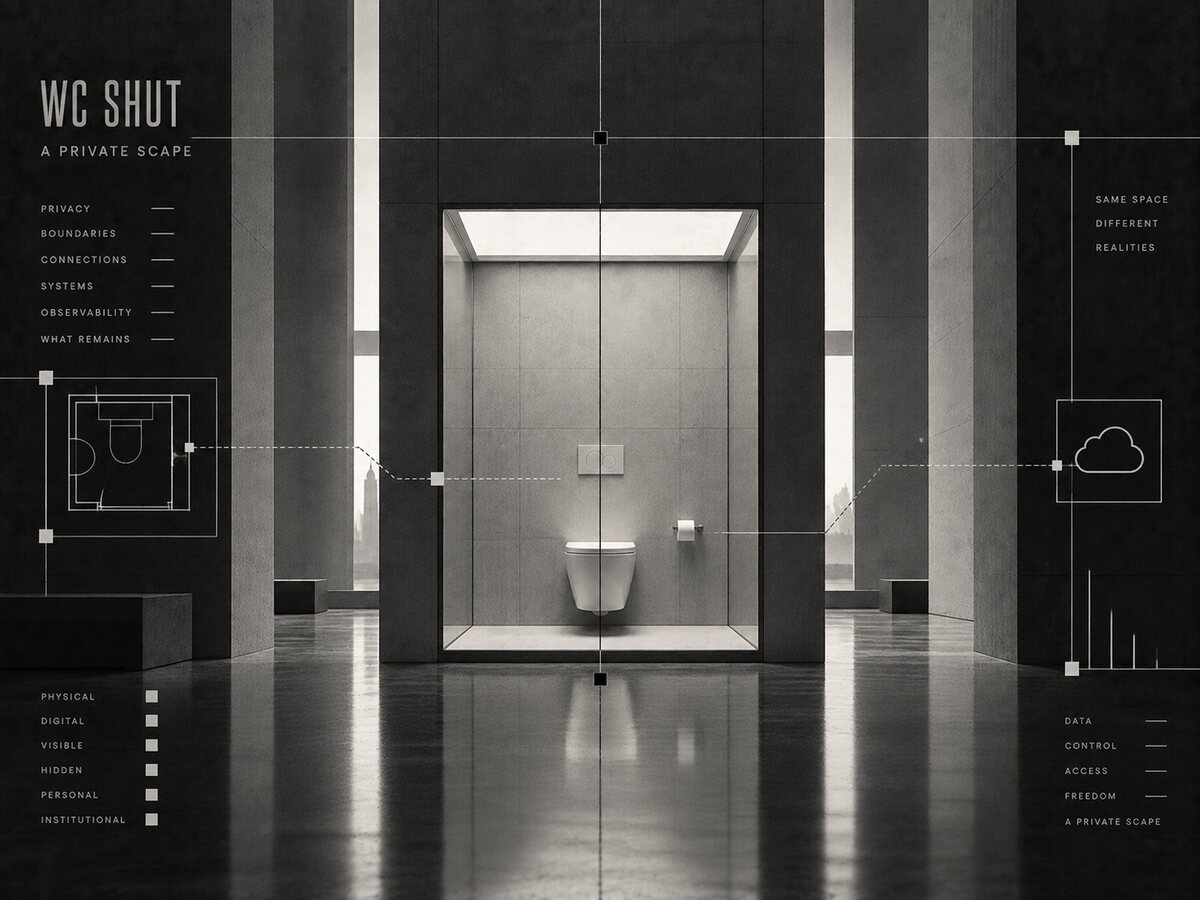
WC Shut: A Private Scape explores privacy, communication and hidden boundaries within intimate systems.
Its starting point is deliberately ordinary: two people may share a home, a routine and a physical environment while continuing to operate through partially separate communicative systems.
The work focuses on one of the most banal spaces in domestic life — the bathroom — and treats it as a temporary interface between the shared environment and the external world.
Behind a closed door, physical proximity remains almost unchanged, yet communicative access can shift completely. A person may still be inside the home while interacting with people, information and systems that remain invisible to the other participant in the shared space.
This produces one of the central propositions of the work:
physical presence does not imply communicative presence.
A system within a system
WC Shut examines the home as a system containing smaller and partially autonomous subsystems.
The shared domestic environment creates a common physical structure. Within that structure, however, privacy introduces boundaries. Devices create additional interfaces. Messages, social networks, calls and external communications connect the individual to systems that extend beyond the immediate environment.
The result can be represented as a sequence of nested systems:
relationship → shared home → private space → device → external network
Each layer changes what can be observed by the other participant.
The individual remains physically inside one system while becoming communicatively active in another.
Privacy and opacity
Privacy is not treated as an anomaly.
Every functioning relationship contains areas that are not continuously observable by the other person. Individual thought, memory, communication and attention cannot be completely shared.
The problem begins when the existence of a boundary is confused with knowledge of what occurs beyond it.
A closed door can be observed.
A mobile phone entering the room can be observed.
The duration of an absence from the shared space can be observed.
The content and function of the communication occurring behind that boundary may remain inaccessible.
This produces a familiar systemic problem: the observer has information about the boundary but incomplete information about the activity beyond it.
The device as interface
Mobile technology radically expands the functional meaning of private domestic space.
A room that once provided temporary physical isolation can now become a complete communication interface.
The user can move from the domestic system into professional, social, emotional or informational environments without physically leaving the home.
The device therefore acts as an operator connecting systems that would otherwise remain spatially separated.
The bathroom becomes important not because of its physical function, but because of its position within the architecture of privacy.
It can operate as a small protected zone in which external communication occurs outside the immediate observation of the shared domestic system.
Presence, access and belonging
WC Shut develops a distinction that appears elsewhere in Ralph Larson’s introspective narrative: position and function are not necessarily equivalent.
A person can be physically inside a relationship and communicatively outside it for a period of time.
Another person can be physically absent while remaining functionally active through messages, memory or expectation.
Belonging therefore cannot be reduced to location.
The individual may occupy several systems simultaneously, and each system provides a different form of access, visibility and participation.
The same physical position may therefore contain multiple functional realities.
The limits of observation
The work is not primarily concerned with discovering what is being hidden.
Its central concern is the limitation imposed on the observer when access to another system becomes partial.
Once direct observation disappears, interpretation begins.
A pattern of longer absences may acquire meaning.
A device consistently taken into a private space may become noticeable.
A change in routine may produce uncertainty.
But the observable pattern does not automatically reveal the explanation.
Opacity creates interpretative pressure, not certainty.
The observing system may therefore generate hypotheses that exceed the information actually available.
Parallel communication
Two people can share the same physical environment while participating in different communicative worlds.
This condition is not exceptional in contemporary life.
Professional messages, family conversations, social networks, private interests and personal exchanges continually create communication streams that are not fully shared with those physically nearby.
WC Shut asks what happens when the existence of those parallel systems becomes particularly visible.
The issue is not simply secrecy.
It is the coexistence of shared physical space and differentiated informational space.
The private scape
The subtitle A Private Scape refers to this temporary communicative landscape.
The private space is small in physical terms but potentially enormous in informational terms.
Behind the boundary, the individual can enter conversations, networks and representations that have no immediate spatial relation to the room itself.
The private scape therefore exists less as architecture than as a combination of boundary, device and access.
The room becomes an interface.
Boundaries without judgment
The systemic approach avoids treating every private boundary as evidence of wrongdoing.
Privacy may perform a legitimate regulatory function. It can preserve autonomy, permit decompression, protect individual communication or simply create temporary distance within an intense shared environment.
The same boundary can, in other circumstances, facilitate concealment.
The observable structure alone does not determine which function is present.
The work therefore separates the existence of a boundary from the interpretation assigned to it.
A boundary can be identified without pretending to know everything that occurs beyond it.
Within the Introspective Narrative corpus
WC Shut: A Private Scape develops the question of system boundaries within the wider framework introduced in The System.
It connects particularly with The Equation of Silence, where incomplete information generates interpretation. In WC Shut, the missing information does not arise primarily from silence but from restricted access to another communicative subsystem.
The work also intersects with The Stabilizer and The Toxic Muse through a recurring distinction between position and function. A person may be physically close but communicatively distant, structurally peripheral but functionally important, or externally absent while remaining internally active.
Across these works, boundaries are not treated as fixed walls. They are interfaces through which information, expectation and regulation move unevenly between systems.
Themes
Systems · System Boundaries · Observation · Privacy · Ambiguity ·
Uncertainty · Interpretation · Internal Functions · Absence ·
Parallel Systems
Edition and availability
WC Shut: A Private Scape is published as a compact paperback edition of approximately 100 pages, forming part of Ralph Larson’s Introspective Narrative corpus.
The complete text is not published online. The work is issued in a limited printed edition and is available through specialist bookshops handling small and independent editions.
For professional and research use, authorised readers may be provided with private digital access. A username and password are required.