Ralph Larson · Independent Edition
Introspective Narrative · Memory, Displacement & Reconstruction
About the work
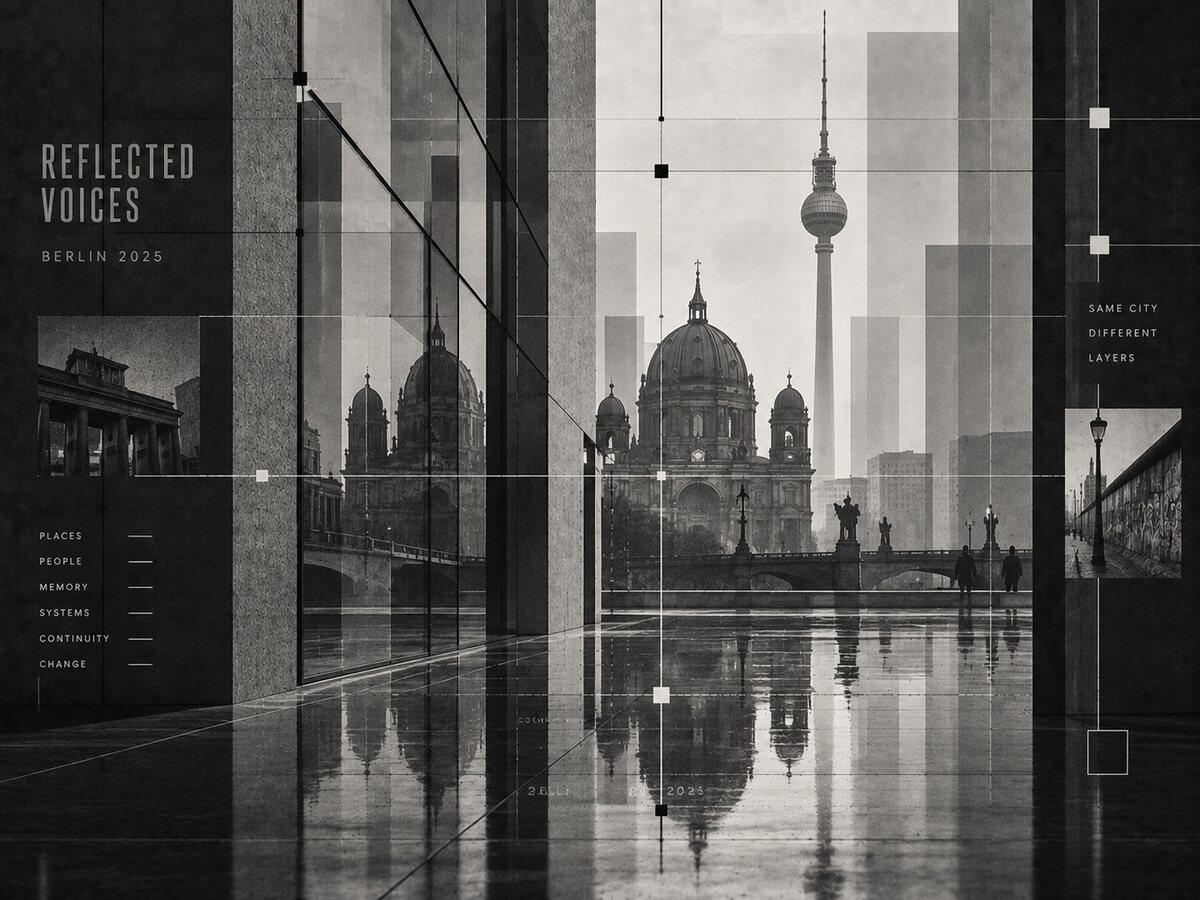
Reflected Voices: Berlin 2025 explores what happens when an observer returns to a place that has already become part of memory.
The work does not treat return as repetition.
The city may be recognisable. Streets, stations, buildings and familiar routes may still exist. But the observer returns carrying a previous representation of the place, and that representation now participates in the new experience.
The second encounter therefore contains more than the city itself.
It contains the memory of the first encounter, the changes that have occurred since then and the expectations produced by what the observer believes he already knows.
This creates the central proposition of the work:
To return is not to repeat the observation. It is to observe what the first observation has become.
The second observation
A first encounter produces information.
A second encounter produces comparison.
The observer no longer sees only what is present. He also sees difference.
A building appears unchanged.
A street feels narrower than remembered.
A station has been renovated.
A neighbourhood that once seemed unfamiliar now feels immediately recognisable.
Each new observation is therefore measured against an internal representation created by the earlier one.
The second observation is not independent.
It is relational.
Berlin then, Berlin remembered, Berlin now
Reflected Voices operates through three different versions of the same city:
Berlin then → remembered Berlin → Berlin 2025
The first is the city originally experienced.
The second is the city reconstructed through memory.
The third is the city encountered again.
None of these versions is completely identical to another.
The remembered city has already been modified by time, later information and the internal development of the observer.
The city encountered again has also changed materially.
Return therefore becomes a comparison between two moving systems: the external city and the internal representation of it.
Reflection as reconstruction
The title refers to reflection in more than one sense.
There is physical reflection: glass, water, architecture, surfaces and the doubled image of the city.
There is also cognitive reflection: the act of returning mentally to something previously experienced.
Both processes create a second image.
The reflected image resembles the original, but it is not the original.
It depends upon angle, position, surface and the observer.
This becomes a model for memory itself.
Memory reflects experience, but every reflection is produced from somewhere.
Voices that remain
The voices of the title are not necessarily literal.
They include remembered conversations, previous interpretations, historical narratives and the internal language through which the observer originally understood the city.
These voices accompany the return.
A place can therefore contain several layers of meaning at once.
What is physically present belongs to the current city.
What is internally activated may belong to another time.
The observer moves through both.
The city as an external system
Berlin functions within the work as an external system whose structure can be observed but never completely known.
Infrastructure, architecture, mobility, institutions and social behaviour continue to change independently of the observer.
The individual encounters only fragments.
A route through the city is therefore always selective.
Some neighbourhoods are crossed repeatedly while others remain unknown.
Certain objects become significant while thousands of others disappear into the background.
The city experienced by the observer is necessarily a partial system.
The internal representation produced from that experience is more selective still.
The observer as a variable
One of the principal differences between a first and second journey is not geographical.
It is the observer.
Time has passed.
Experience has accumulated.
Previous interpretations may have changed.
What once appeared important may no longer attract attention. What was previously ignored may suddenly become visible.
The observer therefore enters the same environment with a different internal configuration.
This changes the observation.
The place can remain stable while the meaning of the place changes because the observer has changed.
Memory under verification
Return creates an unusual opportunity.
A remembered representation can be compared with the external environment that originally produced it.
But the comparison is imperfect.
The city may have changed.
The remembered image may have changed.
The observer may not remember precisely what the earlier environment looked like.
The process therefore does not produce a simple verification of memory.
Instead, it exposes the distance between representation and present observation.
That distance becomes information.
What survives change
Some features of a city survive transformation.
A building remains.
A transport line follows the same route.
An object associated with another period continues to circulate.
These continuities can create the impression that the past remains accessible.
But continuity of objects does not imply continuity of systems.
The surrounding social, technological or institutional context may have changed completely.
A surviving object therefore performs a different function in the present from the one it performed when it was ordinary.
This connects Reflected Voices with the broader systemic interest in elements that outlive the configurations that originally gave them meaning.
The impossibility of exact return
Return often carries an implicit expectation of recognition.
The observer expects to find something familiar.
Recognition may occur.
But exact repetition remains impossible.
The temporal sequence cannot be reversed.
The city experienced previously no longer exists exactly as it did, and the person who experienced it no longer occupies the same internal position.
The return is therefore not a recovery of the earlier experience.
It is a new experience constructed in relation to it.
Reflected meaning
The second encounter can also modify the first.
A place that once seemed central may become peripheral.
An earlier interpretation may appear excessive.
A detail forgotten for years may suddenly acquire significance when the observer sees the location again.
The new experience therefore does not merely add another layer to memory.
It can reorganise the earlier layers.
New observation changes not only what the observer knows now, but also what the observer believes the earlier experience meant.
Reconstruction without certainty
The work does not attempt to reconstruct a definitive version of Berlin.
Such a version would be impossible.
The city exceeds any individual observation.
Memory exceeds simple retrieval.
The observer changes continuously.
What can be reconstructed is a relationship between these elements.
The value of the second encounter lies not in eliminating uncertainty but in making the transformations between observations visible.
Within the Introspective Narrative corpus
Reflected Voices: Berlin 2025 develops the questions of memory, displacement and observation explored in Trabant Nights.
Trabant Nights follows movement through Berlin and examines how the journey produces internal representation. Reflected Voices begins from the existence of that representation and asks what happens when the observer returns to the external environment from which it emerged.
The work also connects with The Threshold, where a present observer repeatedly reconstructs an earlier event, and with Metanoia, where transformation changes the position from which previous experience is interpreted.
Across these works, memory is never treated as a passive archive.
It is an active interface between previous experience and the system observing it in the present.
The remembered past remains available, but every act of access occurs from a new position.
Themes
Memory · Observation · Interpretation · Internal Representation ·
Identity · Systems · Transformation · Adaptation · Uncertainty ·
System Boundaries
Edition and availability
Reflected Voices: Berlin 2025 is published as a compact paperback edition of approximately 100 pages, forming part of Ralph Larson’s Introspective Narrative corpus.
The complete text is not published online. The work is issued in a limited printed edition and is available through specialist bookshops handling small and independent editions.
For professional and research use, authorised readers may be provided with private digital access. A username and password are required.