Ralph Larson · Independent Edition
Introspective Narrative · Memory, Displacement & Reconstruction
About the work
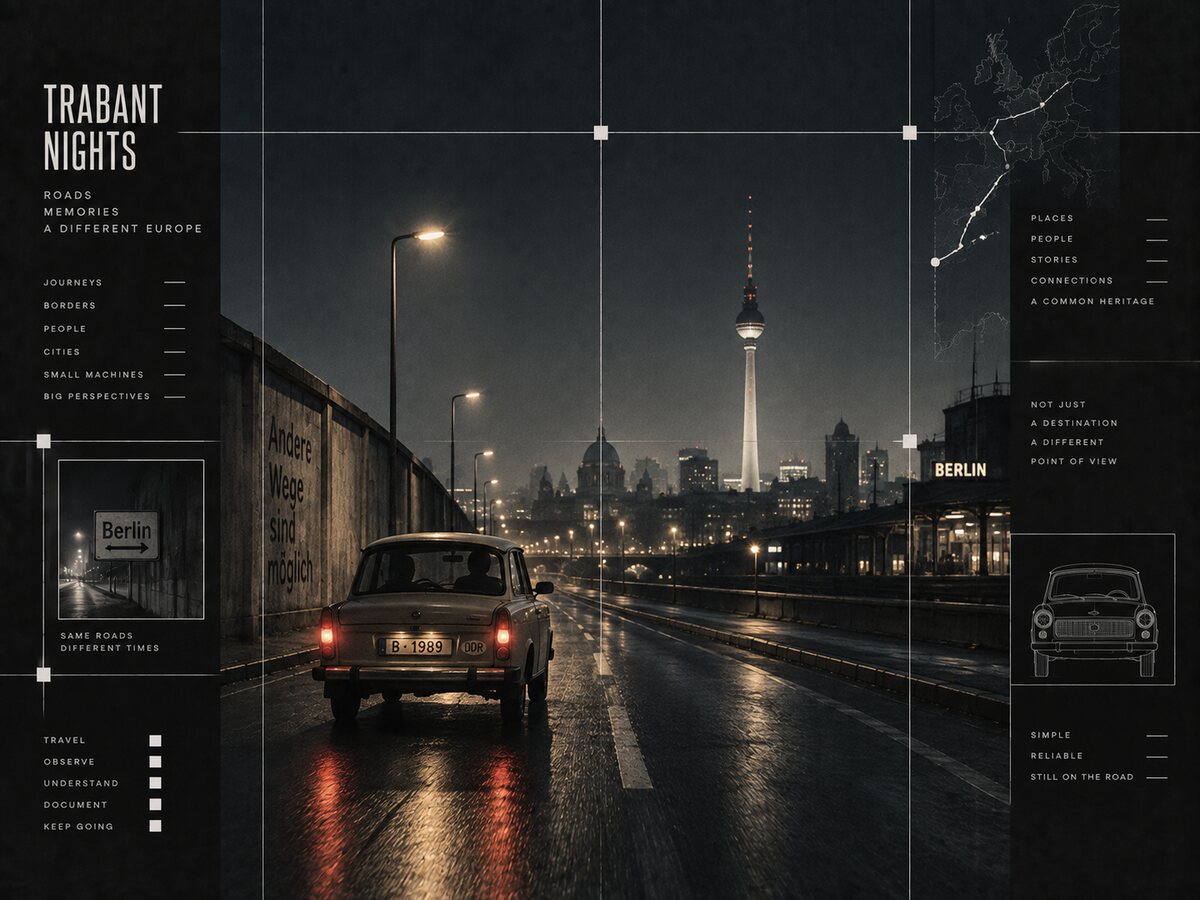
Trabant Nights is an introspective travel narrative about movement, memory and the changing position of the observer.
Its landscape is Berlin, but the journey does not operate only through geography. Streets, buildings, vehicles, objects and fragments of the city become points of contact between different moments in time.
The traveller moves through a physical environment while simultaneously moving through representations accumulated before, during and after the journey.
The result is not simply a record of Berlin.
It is an exploration of what happens when an observer enters a place already populated by memory, expectation and interpretation.
Every journey changes the position from which the previous journey is remembered.
The journey as observation
Travel changes the informational environment of the observer.
Familiar routines disappear. Attention becomes more selective. Objects that would normally remain unnoticed acquire significance because they belong to a different landscape.
The traveller observes more deliberately.
But observation is never completely neutral.
What is noticed depends partly on what the observer already carries: previous knowledge, memories, expectations, associations and interests.
The city being observed and the city being reconstructed internally are therefore related but not identical.
Berlin as a layered system
Berlin appears in Trabant Nights not as a static setting but as a system containing multiple historical layers.
Buildings survive political systems that created them. Streets retain traces of previous boundaries. Infrastructure is reused. Objects move from ordinary utility into historical memory.
The present city therefore contains information belonging to configurations that no longer exist.
The observer encounters these layers simultaneously.
A railway station can belong to the present while activating a historical representation. A building can perform a contemporary function while preserving the architecture of another period. A vehicle can operate both as a machine and as an object of memory.
The past does not need to remain intact in order to remain observable.
The Trabant as an interface
The Trabant occupies a particular position within the narrative.
It is not merely a nostalgic object and does not function simply as a symbol of a disappeared political system.
It is a technical object that has survived the environment for which it was originally designed.
Its continued existence changes its meaning.
What was once ordinary transportation can later become historical evidence, mechanical curiosity, cultural reference and personal object simultaneously.
The vehicle therefore becomes an interface between systems separated by time.
It moves through the contemporary city while carrying information from another technological and social configuration.
Displacement
Physical displacement changes more than location.
Moving through a city reorganises attention.
Distances that appeared abstract become measurable through movement. Places previously known through photographs, maps or historical accounts acquire physical scale.
The observer must reconcile prior representation with direct experience.
Sometimes the two coincide.
Sometimes they do not.
The difference between imagined space and experienced space becomes new information.
Night as an observational condition
Night changes the city without changing its underlying structure.
Traffic diminishes. Buildings lose part of their daytime function. Artificial light isolates details that daylight integrates into a larger environment.
The familiar can become temporarily unfamiliar.
This altered informational environment creates another form of displacement.
The observer moves through the same physical system under different conditions of visibility.
The city has not become another city.
But it can be observed as one.
Memory and reconstruction
Memory does not reproduce experience mechanically.
It reconstructs it.
Some details disappear while others acquire disproportionate importance. Later knowledge modifies earlier interpretations. Images, conversations and subsequent journeys enter the representation of the original event.
The remembered journey therefore becomes a new configuration.
This does not necessarily make memory false.
It makes memory dynamic.
To remember is not simply to retrieve information. It is to encounter that information from a different present.
The changing observer
The traveller who returns is not identical to the traveller who left.
This is true even when the physical journey is short.
New information has entered the system.
Some expectations have been confirmed. Others have disappeared. Places that existed previously as representations now have sensory and spatial associations.
The observer has changed position.
If the journey is repeated years later, the problem becomes even more visible.
The same street may be encountered by a different version of the observer.
The physical coordinates can remain stable while their internal meaning changes.
Returning without returning
Return is one of the central problems of Trabant Nights.
A person can return geographically.
The same station can be reached again. The same street can be crossed. The same building can still exist.
But temporal return is impossible.
The environment may have changed.
The observer certainly has.
Return therefore produces comparison rather than restoration.
We can return to a place. We cannot return to the position from which we first observed it.
Objects that outlive their systems
The narrative repeatedly encounters objects whose original environments have disappeared.
Vehicles, architecture, signs, machinery and everyday artefacts can survive the systems that once made them ordinary.
Their persistence creates an unusual informational condition.
The object is physically present, but part of its meaning belongs to an absent structure.
To understand it, the observer must reconstruct context.
The surviving object therefore becomes a point at which material continuity and systemic discontinuity meet.
It remains the same object while occupying a different informational world.
Nostalgia and observation
Trabant Nights does not treat nostalgia as a method of historical interpretation.
Affection for an object, city or period is itself information about the observer.
It does not establish the qualities of the historical system being remembered.
This distinction allows fascination and critical observation to coexist.
An object can be admired without idealising the environment that produced it.
A disappeared landscape can be reconstructed without pretending that disappearance transformed it into something better than it was.
The observer is permitted attachment, but attachment remains part of the observation.
The city as internal representation
Eventually, the journey ends.
The physical city remains where it was.
What travels back with the observer is a representation.
That representation can continue changing long after the geographical movement has stopped.
Photographs are revisited. Details acquire new connections. Later information modifies previous interpretations. Memory selects and reorganises.
Berlin therefore continues to exist within the narrative as an internal system constructed from direct experience, historical information and subsequent reconstruction.
The journey continues after movement ends.
Within the Introspective Narrative corpus
Trabant Nights occupies a particular position within Ralph Larson’s Introspective Narrative corpus because it places the systemic observer inside a concrete geographical journey.
The methodological problem introduced in The System remains present: the observer participates in the system being observed. Here, however, that problem is explored through movement, landscape, objects and memory rather than primarily through abstract systemic analysis.
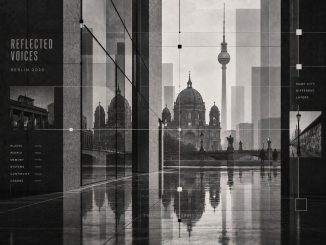
The work connects directly with Reflected Voices: Berlin 2025, which returns to Berlin from another observational position and develops the problem of reconstruction through a later encounter with the city.
It also intersects with The Threshold, where the present observer reconstructs an earlier event, and with Metanoia, where transformation changes the position from which previous experience is interpreted.
Across these works, memory is not treated as an archive untouched by time.
The past remains available, but the observer accessing it does not remain unchanged.
Themes
Memory · Identity · Observation · Systems · Adaptation ·
Transformation · Internal Representation · System Boundaries ·
Uncertainty · Interpretation
Edition and availability
Trabant Nights is published as an extended paperback edition of approximately 200 pages, forming part of Ralph Larson’s Introspective Narrative corpus.
The complete text is not published online. The work is issued in a limited printed edition and is available through specialist bookshops handling small and independent editions.
For professional and research use, authorised readers may be provided with private digital access. A username and password are required.