
Ralph Larson · Independent Edition
Introspective Narrative · Everyday Systems
About the work
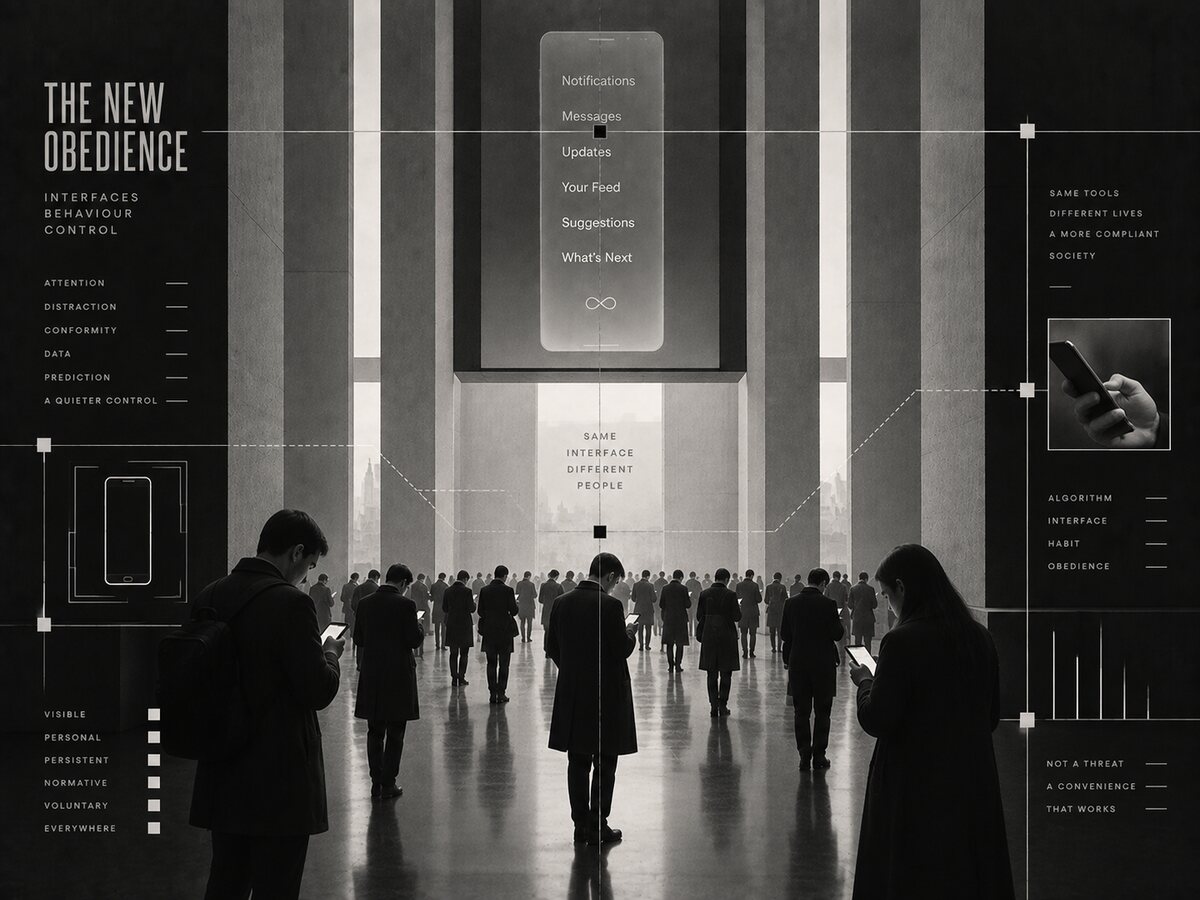
The New Obedience explores a form of everyday obedience that does not depend upon visible authority, explicit instructions or direct coercion.
Contemporary systems increasingly organise behaviour through interfaces.
A notification appears.
A message is marked as read.
An application requests attention.
A platform suggests the next action.
A device remains permanently within reach.
None of these elements necessarily constitutes an order.
Yet together they can create patterns of conduct that become remarkably difficult to interrupt.
This produces the central proposition of the work:
Obedience no longer requires a visible command. Sometimes an interface is enough.
Obedience without orders
Traditional obedience is easy to represent.
Someone commands.
Someone else complies.
The relationship between authority and behaviour is visible.
Interface-mediated behaviour is different.
The command may disappear entirely.
No person tells the user to check a screen, respond immediately or remain continuously available.
The system instead creates conditions in which these behaviours become expected, repeated and eventually normal.
Compliance can therefore emerge without an identifiable moment of instruction.
The interface as environment
An interface is normally understood as a tool through which a person interacts with a technological system.
But interfaces do more than provide access.
They organise possibilities.
They decide what appears first, what remains visible, what requires acknowledgement and what can be ignored.
Buttons, notifications, counters, alerts and default options create an architecture of attention.
The interface does not determine every decision.
It structures the environment in which decisions are made.
The architecture of attention
Attention is limited.
Digital systems compete continuously for a portion of it.
A vibration interrupts another activity.
A number indicates that something remains unread.
A symbol changes colour or position.
A message appears on a locked screen before the user has decided to open the application.
Each signal is small.
The cumulative effect can be substantial.
What repeatedly requests attention may eventually acquire priority without ever having demonstrated importance.
From action to habit
A single interaction has little systemic significance.
Repetition changes the structure.
Checking becomes habitual.
Immediate response becomes expected.
Availability becomes normal.
Absence begins to require explanation.
The behaviour is no longer produced exclusively by the original signal.
The observing system begins to anticipate the signal before it appears.
At that point, external instruction has become partially internalised.
The expectation of availability
Digital communication has altered the informational meaning of availability.
A person can be physically absent while remaining technically reachable.
This creates a new expectation.
If communication is technically possible, silence may require interpretation.
If a message has been delivered, delay becomes observable.
If presence can be indicated, absence becomes information.
The system therefore generates expectations that extend beyond the technology itself.
Interfaces begin to regulate relationships between people who may never consciously have agreed upon the rules they are following.
Defaults and invisible decisions
Not every decision begins with an explicit choice.
Many technological systems arrive already configured.
Notifications are enabled.
Applications start automatically.
Services remain connected.
Information is synchronised.
The default position becomes the path requiring least intervention.
This does not eliminate autonomy.
But it changes its cost.
When compliance is automatic and refusal requires configuration, the architecture of choice is already asymmetrical.
Convenience and dependence
The systems examined in The New Obedience are useful.
This is important.
The work does not depend upon the assumption that technology is inherently hostile or that convenience is a form of deception.
Navigation, communication, authentication, payment and access to information can become substantially easier through digital interfaces.
Utility explains adoption.
But repeated utility can also produce dependence upon a particular mode of interaction.
The relevant question is therefore not whether the system is useful.
It is what patterns emerge once the useful system becomes the normal environment.
The internalisation of the interface
The most effective interface does not need to remain continuously visible.
Its logic can be internalised.
The user anticipates messages.
Checks without receiving a notification.
Feels that a response is overdue.
Experiences temporary disconnection as informational absence.
The system has moved beyond the screen.
Part of its regulatory structure now operates within the user.
The interface has become an expectation.
Observation before judgement
The New Obedience does not begin by asking whether these behaviours are good or bad.
It asks what function they perform.
Does repeated checking reduce uncertainty?
Does immediate response preserve social expectations?
Does continuous connection provide security?
Does conformity reduce the effort required to navigate a technological environment?
A systemic approach observes the pattern before attributing intention or moral meaning to it.
First function; then, if appropriate, meaning.
Resistance without rejection
Autonomy does not necessarily require abandoning the system.
A person may use the same device, applications and communication channels while changing the way they regulate attention.
Notifications can remain unanswered.
Availability can become selective.
Defaults can be modified.
Technological convenience can be accepted without accepting every behavioural expectation attached to it.
This creates a distinction between participation and obedience.
Using a system does not require surrendering observation of the system.
The new obedience
The obedience described by the title is therefore not absolute.
It is ordinary.
It consists of thousands of minor adjustments made in response to systems that structure everyday behaviour.
Most are individually insignificant.
Together they can establish patterns that appear natural precisely because no identifiable authority imposed them.
The system does not need to say:
Obey.
It may only need to make one behaviour easier, more visible or more expected than another.
Within the Introspective Narrative corpus
The New Obedience extends Introspective Narrative from internal and relational systems into the technological environment of everyday life.
It connects with Specialty Coffee, where repetition and implicit rules transform an ordinary interaction into a regulatory pattern.
It also connects with WC Shut: A Private Scape, where the mobile device creates a communicative environment operating inside another physical and relational space.
But The New Obedience changes the scale of observation.
The question is no longer simply what a particular interaction means.
It is how repeated interaction with technological systems can reorganise attention, expectation and behaviour.
The work leads directly to Fifth Column, which examines a different possibility: remaining inside the system while declining to reproduce all of its patterns.
Participation does not necessarily require obedience.
Themes
Systems · Observation · Self-Regulation · Internal Functions ·
Expectation · Uncertainty · Adaptation · System Boundaries ·
Perturbation · Functional Conflict
Edition and availability
The New Obedience is published as a compact paperback edition of approximately 100 pages, forming part of Ralph Larson’s Introspective Narrative corpus.
The complete text is not published online. The work is issued in a limited printed edition and is available through specialist bookshops handling small and independent editions.
For professional and research use, authorised readers may be provided with private digital access. A username and password are required.